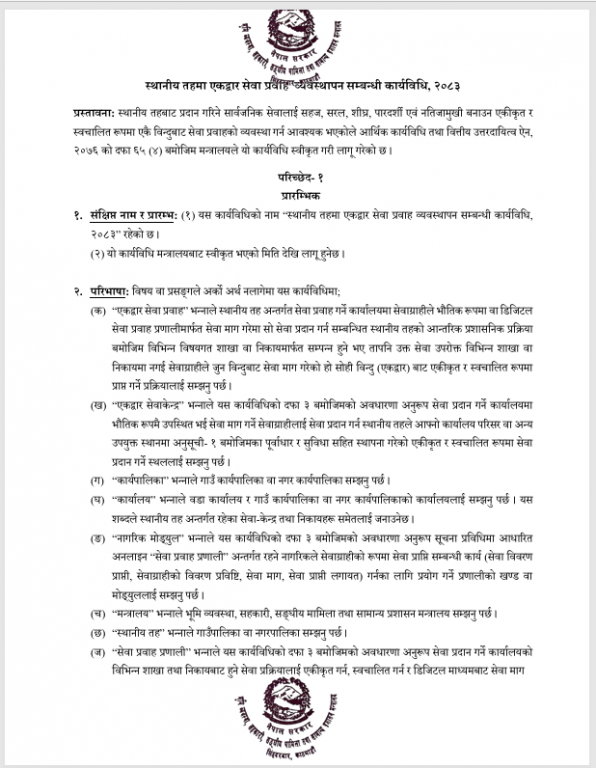
Call for Experts from Provincial Research and Training Center (PRTA)

Provincial Research and Training Center (PRTA) of following provinces have announced call for experts: 

ppd.bagamati@plgsp.gov.np

PPIU Bagmati Province conducted a one-day Provincial Coordination Committee(PCC) meeting

PPIU Bagmati Province conducted a one-day Provincial Coordination Commi

Body

Executive Summary of Report
The Provincial and Local Governance Support Programme (PLGSP) is the national flagship Programme of the Government of Nepal (GoN) to build institutional, organizational and individual capacity at all levels of government, with special focus on the provincial and local levels. The ultimate goal of the Programme is to attain functional, sustainable, inclusive and accountable provincial and local governance. The Programme aims to contribute in delivery of quality services at provincial and local levels, promote local development and enhance economic prosperity. This report covers the progress for the period of 16 July 2021 to 15 July 2022.

Progress in the reporting period has improved compared to previous two fiscal years. The noteworthy progress includes start of IPF implementation, GESI/audits completed and endorsed GESI strategies in LGs, training of LGs officials and elected representatives in various thematic areas, the roll out of FRA and orientation of LGs on MTEF and the preparation of PIS system for PG. Progress against each of the planned activities is described in the text.

Key achievements of the reporting period have been summarized as follows:

PCU Level

  • Third Party Monitoring of PLGSP has been completed and recommendations have been incorporated while developing ASIP 2022 - 2023. The next round of third party monitoring is underway and the first draft report is due for completion.
  • The MTR of PLGSP completed and a comprehensive MTR report prepared in a wider consultation has been received.  The report has been concluded with six main recommendations for the remaining period of the programme including implementation modality, planning & budgeting, outcome-1, use of TA, sectoral service and holistic ID/OD. A process of stakeholder consultation and reprogramming of PLGSP for the future is initiated.
  • 5 different guidelines have been prepared for local governments.
  • 4 different model laws have been prepared for the local governments.
  • 17 training modules have been developed for PCGG.
  • Personal Information System (PIS) for provincial government has been developed, and is ready to hand over.IT support has continued in all 753 LGs.
  • SUTRA rolled out in all 753 LGs.
  • IT, GESI, PFM experts, along with government officials, have been trained to enhance their capacities.
  • PCU has supported PCGGs to conduct orientation to newly-elected representatives of the local governments.
  • 66 resource persons have been trained (MToT) on MTEF, to be mobilized by PCGG.  


Province - PCGGs

  • 213 LGs have prepared their Revenue Improvement Action Plan (RIAP).
  • 424 LGs have completed their GESI Audit.
  • 439 LGs have prepared their GESI Strategy.
  • 36 LGs have implemented code of conduct on workplace sexual harassment.
  • 165 LGs have prepared capacity development (CD) plan.
  • 65 LGs have prepared their periodic plan.
  • 509 LGs have been orientated on MTEF.
  • 17 LGs have implemented an internal control system.
  • 699 LGs have implemented LISA.
  • 525 LGs have conducted FRA and 312 LGs uploaded the findings in the online portal.
  • 89 LGs have implemented accountability tools.
  • Province-1 has passed PCGG Act by the provincial assembly.
  • 2 PCGGs have prepared master/business plan.
  • Total 38,551 (F – 9,658) officials and elected representatives of the PLGs have been trained on different thematic areas. By ethnicity, participants were 17.1% Janjati, 11.2% Madheshi, 7.4% Dalit, 1.3% Muslim and 63% others.


Province - PPIUs

  • Information system of PG ministries have been strengthened in all provinces.
  • Provincial Coordination Committee meetings have been conducted in all seven provinces.
  • 2 provinces have started the Hello CM (grievances handling system).
  • 26 laws have been drafted by the provincial government.
  • PGs have prepared 2 model laws for LGs.
  • Lumbini province has prepared SDG localization guidelines for provincial governments.
  • Five Provinces have prepared and endorsed their Fiduciary Risk Assessment guidelines and conducted orientation on provincial FRA procedure to PG’s officials.
  • 8 ministries at provinces have conducted GESI audit.
  • Provincial Coordination Committee meetings have been conducted in all seven provinces.
  • IPF implementation guidelines have been prepared and approved by NSC.
  • 57 IPF projects are being implemented. Of the total budget 1352.452 million, 14% has been spent in the reporting period which is 41% of the total budget released by provinces to the IPF implementing agencies.

The reporting period also marks some major learning, including the creation of PLGs’ websites with regular updates which have raised citizens’ awareness regarding budgets, expenditure, programme and priorities. Quality assurance mechanisms at province and federal level has been a vital initiative while pursuing the consulting service to deliver programme outputs. Furthermore, focused/targeted interventions through GESI audit, Gender Responsive Budgeting, GESI strategy has also worked very well to mainstream and institutionalize GESI in the plan and policy of the provincial and local governments.

The programme also continued to face some issues/challenges including low ownership of the programme at the provincial and local level, low financial delivery (though increased in the reporting period compared to the previous two years), legislating for PCGGs and re-structuring the existing LDTA and strengthening the relationship among the three levels of government.

The total budget of the Annual Work Plan (AWP) for 2021/22 was NPR 3386.950m including NPR 2919.500m JFA, 37.200m GoN, and 430.250m TA. Against the total budget, NPR 1730. 273 million (51.08 %) was utilized as of the end of F.Y. 2021/22. Similarly, under the TA, 55.51 % of the total planned budget (NPR 430.250 million) was spent during the reporting period. Of the total expenditure, NPR 479.640245m (27.72 %) was spent on GESI-related activities including both in dedicated outputs and others as cross cutting measures in TA and JFA.

Institutionalizing various systems, policies, strategies, guidelines and tools delivered by the programme so far, implementing IPF in full compliance to the operational guidelines, capacity development of individual PLGs officials and elected representatives with a focus on newly-elected representatives, implementing MTR recommendation, monitoring and quality assurance and increasing the financial delivery are the key priorities, among others, for the next fiscal year.

Display at Home Page
On
Document Cover Image
Cover Page of Annual Progress Report (FY 2078-79-2021-22)
Provice
Body

Provincial and Local Governance Strengthening Programme (PLGSP) is a flagship initiative by the Government of Nepal (GoN) aimed at enhancing policy support, institutional development, and capacity building at Provincial and Local Government (PLG) levels. The programme respects the principles of devolution and local autonomy, ensuring that it meets the specific needs of these governments while fostering cooperative federalism. Led by the Ministry of Federal Affairs and General Administration (MoFAGA) and supported by the European Union (EU), Foreign, Commonwealth and Development Office (FCDO), Swiss Agency for Development and Cooperation (SDC), Norwegian Government, and the United Nations Development Programme (UNDP), it aims to promote inclusive, accountable, and effective governance, translating constitutional commitments into practice and improving service delivery for citizens. The main goal of the programme is to attain the functional, sustainable, inclusive, and accountable provincial and local governance. In line with this goal, it has two objectives: strengthen provincial and local governance systems and procedures, and intergovernmental (IG) relationships to maximize benefits of cooperative federalism for Nepali people; and enhance the capacity of provincial and local governments to deliver services and development outcomes effectively to people. To contribute the stated goal and objectives, three outcomes, one each at federal, province and local level are designed at higher level, while three outputs are designed under each of these outcomes.

PLGSP’s implementation arrangement comprises of Programme Coordination Unit (PCU) under MoFAGA, Provincial Programme Support Units (PPSU) under Office of the Chief Minister and Council of Ministers (OCMCM), and technical assistance at provincial and local levels. Although the programme was designed to begin in July 2024 for a five-year period (2024-2029), implementation was delayed. The Programme Document (ProDoc) was formally endorsed only in February 2025, leaving less than six months of implementation timeline during the GoN’s Fiscal Year 2080/81 (from mid-July 2024 to mid-July 2025). The total budget for PLGSP in FY 2024/25 stood at NPR 1,814 million, comprising NPR 1,515 million under JFA and NPR 299 million for TA. Of this, the programme utilized NPR 801 million, representing an overall budget execution rate of approximately 44 percent. This includes NPR 657 million expenditures under JFA, NPR 144 million under TA. The combined planned budget across all seven provinces was NPR 1,012 million, out of which NPR 290 million was spent during the reporting period. These figures highlight the need for strengthening implementation planning and financial execution capacities next year and beyond. It is important to note that the programme advanced on several fronts despite these constraints.

Despite these initial delays and challenges, the programme achieved meaningful progress at federal, provincial, and local levels during the reporting period. They include:

  • Local governments (LGs) now have a dedicated IT officers co-funded by PLGSP. This has strengthened digital services and improved record-keeping across all 753 municipalities.
  • Provincial governments (PGs) have endorsed important laws to strengthen local governance. Sudurpashchim Province enacted a Provincial Local Service Act that has laid the foundation for a professional local civil service. Similarly, Koshi Province drafted four new laws, including two provincial Acts and two model laws for municipalities.
  • PGs have been adopting new digital systems for more efficient, transparent administration. Koshi Province connected all 137 municipalities to an integrated Government Integrated Office Management System (GIOMS) to improve record-keeping and accountability. Madhesh Province introduced a personnel information system and piloted an e-Cabinet for paperless government meetings. Lumbini Province rolled out an e-procurement platform to make public spending more transparent.
  • LGs are strengthening their planning and accountability systems. Many municipalities have adopted tools such as the Local Institutional Self-Assessment (LISA) and the Medium-Term Expenditure Framework (MTEF) to improve planning and monitor performance. Currently, 734 out of 753 local governments (81.22%) conduct LISA annually, ensuring systematic self-assessment. Notably, in Koshi and Sudurpashchim provinces, all 137 and 88 municipalities respectively now use LISA every year, creating a consistent approach to track progress and address local priorities effectively.
  • Capacity building took place across all provinces. Over 11,700 provincial and local representatives were trained in resultsbased planning, financial management, monitoring, and inclusive service delivery. This effort is creating a more capable local workforce.
  • Gender Equality and Social Inclusion (GESI) was a priority throughout. Three provinces i.e. Bagmati, Karnali, and Sudurpashchim carried out GESI audits to identify gaps, with Sudurpashchim completing 19 audits this year alone. Madhesh developed GESI action plans and trained focal persons in six districts to put those plans into practice. These efforts are making local planning more gender-responsive and inclusive, though there’s still room for improvement. • LGs launched innovative pilot projects with support from PLGSP’s Innovative Partnership Fund (IPF). Gandaki Province invested in digital education to reach rural students, Koshi supported women-led kiwi farming enterprises to boost local incomes, Lumbini piloted eco-tourism initiatives, and Karnali developed ICT-based planning tools for LGs. These community-driven projects show how small investments can create practical solutions that local governments can sustain and scale up.
  • Joint monitoring visits improved transparency and feedback. Officials representing MoFAGA, PGs, Development Partners (DPs), and civil society conducted joint field visits to review progress. These collaborative reviews let local communities give feedback and helped PLGSP make quick course corrections. PLGSP even used lessons from the field to update the IPF guidelines, ensuring federal policies better align with local needs.
  • Low first-year spending highlighted the need to accelerate implementation. Provinces on average used only about 12-37 percent of their budgets, except Sudurpashchim which achieved around 61 percent, mainly due to the late start. PLGSP is tackling this by strengthening planning and support so that next year more of the budget turns into tangible results.
  • A unified Monitoring and Evaluation framework has been rolled out with an online Management Information System (MIS) to enable real-time tracking of results and feeding into Nepal’s first “State of Federalism” report, a major step toward evidence-based policymaking. This digital M&E system has laid the groundwork for more transparent and accountable governance across all levels.
  • New collaborative platforms such as Provincial Coordination Councils and Provincial Steering Committees have been established to institutionalize regular dialogue among federal, provincial, and local officials. These forums have strengthened joint planning and problem-solving to exemplify that cooperative federalism in action and that different tier of government work together to address local needs.
  • Women’s leadership in local governance is gaining momentum. Madhesh trained 132 women leaders through transformative programs, Koshi capacitated 83 Judicial Committee members. These efforts are helping bridge gender gaps and promote inclusive, representative decision-making across provinces.


Click here to access PDF copy of annual report: 

Display at Home Page
On
Document
Document Cover Image
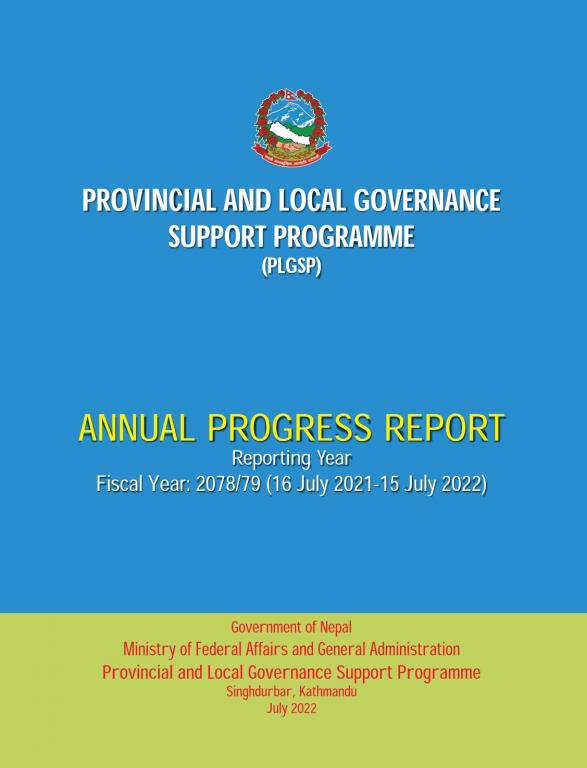
Cover page of Annual Progress Report 2024-25
Provice
Subscribe to